
Quick Listen:
Imagine a world where your smartwatch doesn’t just track your steps it instantly notifies your doctor if your heart rhythm becomes irregular. Or picture a simple sensor on your medication bottle that gently reminds you to take your pills while securely sharing adherence data with your care team. This vision is rapidly becoming reality through the Internet of Things in healthcare communication, where connected everyday devices are forging powerful links between patients, providers, and health systems to save time, prevent errors, and genuinely enhance lives.
For too long, healthcare communication has been fragmented: doctors searching for paper records, patients missing follow-up appointments, and chronic conditions worsening because subtle changes go unnoticed. The Internet of Things (IoT) is transforming this reality by creating seamless, real-time connections that deliver the right information to the right people at the right moment without replacing the essential human element of care.
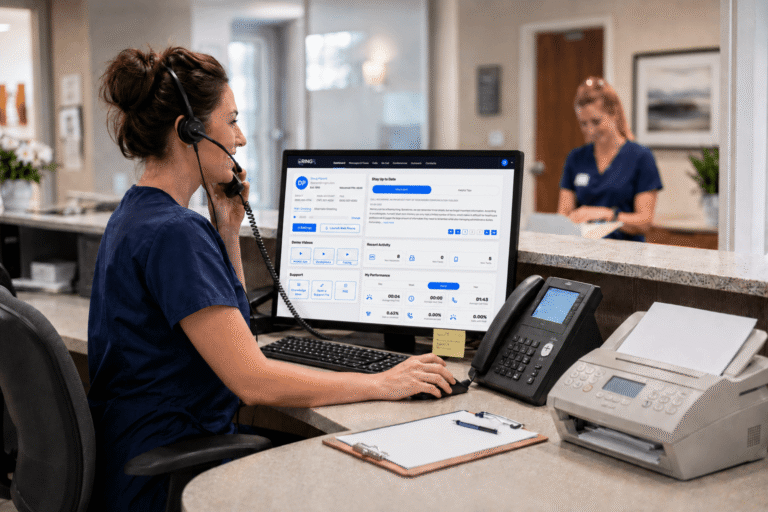
Missed calls, scattered text messages, voicemails buried in separate apps disrupt patient care and expose practices to compliance risks. Erodes patient trust, longer waits and wasted staff time. RingRx changes that by combining voice, secure texting, fax, video visits, and on-call scheduling into one intuitive, fully HIPAA-compliant platform designed specifically for medical workflows. See how your practice can grow, run more smoothly, and deliver a better experience for every patient. Sign Up for RingRx Free Trial today!
How IoT Is Transforming Healthcare Communication
At its foundation, IoT in healthcare involves embedding intelligent sensors, wearables, and connected devices throughout the care journey. These tools continuously gather vital signs, activity levels, medication adherence, and other key data, then transmit it securely and instantly to clinicians and patients alike.
Consider a patient recovering at home following surgery. Rather than relying on frequent in-person visits or worried phone calls, a discreet wearable patch monitors heart rate, oxygen saturation, and mobility. Should any metric deviate from expected ranges, the system immediately sends an alert to the care team via text, mobile app notification, or clinical dashboard. This enables swift intervention that often prevents minor issues from escalating into costly hospital readmissions.
This fundamental shift moves healthcare from a reactive model treating problems after they arise to a proactive one, where communication flows continuously and naturally. Patients experience a greater sense of support and connection, while providers gain unprecedented visibility into real-world health patterns that extend far beyond the walls of the examination room.
Enhancing Patient Engagement Through Connected Technology
One of the most powerful outcomes of IoT adoption is its ability to drive authentic patient engagement . When individuals can easily view and understand their own health data such as blood pressure trends, sleep quality, or glucose fluctuations they transition from passive recipients of care to active partners in managing their wellbeing.
User-friendly apps paired with connected devices convert general medical advice into personalized, actionable insights. A person living with diabetes might receive timely nudges based on actual glucose readings rather than estimates. Someone managing hypertension can observe how daily choices influence their numbers and make informed adjustments, all while their physician remains informed through secure channels.
Solutions in this space increasingly incorporate AI-driven engagement tools and accessible web-based platforms, making interactions feel intuitive and supportive. The true measure of success lies not in impressive market figures but in tangible improvements: higher medication adherence rates, fewer missed appointments, and deeper trust between patients and their care teams.
Revolutionizing Chronic Disease Management
Chronic conditions represent a significant portion of healthcare challenges and costs. Here, IoT delivers exceptional value by enabling continuous, non-intrusive monitoring that reduces the need for constant in-person oversight.
Connected glucose monitors, for example, transmit readings directly to secure cloud platforms where intelligent algorithms can detect concerning patterns early. Patients with heart failure benefit from smart scales and chest patches that identify fluid retention days before symptoms become severe. These insights allow care teams to make timely treatment adjustments often through a simple message or virtual consultation preventing unnecessary emergency visits.
Communication in chronic care becomes truly bidirectional. Patients can readily pose questions through integrated apps, while providers can deliver personalized education or motivational support grounded in real-time data. This ongoing dialogue helps reduce the sense of isolation many patients experience and fosters sustainable health habits that last.
Optimizing Hospital and Clinic Operations
The impact of IoT extends well beyond individual patients to reshape how entire healthcare facilities function and communicate internally.
Smart hospital beds can automatically detect when a patient requires assistance and direct the alert to the closest available nurse. Asset tracking solutions provide instant visibility into the location of critical equipment such as infusion pumps or mobility aids, dramatically reducing time wasted on searches. Staff can communicate more efficiently through connected badges or apps that deliver targeted, urgent notifications without the disruption of traditional overhead paging systems.
These operational enhancements free up valuable time for direct patient interaction. When devices and systems communicate seamlessly with one another, medical errors decrease, response times improve, and the overall care environment becomes calmer and more focused on healing.
The Role of Secure Messaging in Modern Care
Complementing broader IoT ecosystems, healthcare organizations are increasingly adopting reliable application-to-person SMS platforms to ensure secure, immediate communication with patients. These channels support appointment reminders, medication alerts, and educational follow-ups in ways that feel both personal and dependable, further strengthening the connected care experience.
Addressing Key Challenges and Building Trust
While the potential of IoT in healthcare communication is immense, important considerations must be addressed to ensure responsible implementation. Protecting sensitive patient data remains a top priority as information travels across connected networks. Achieving true interoperability enabling devices from various manufacturers to work together without friction continues to be an area of active development. Additionally, ensuring equitable access for all patients, regardless of technology availability or digital literacy, is essential for inclusive progress.
Fortunately, meaningful solutions are advancing rapidly. Industry-wide adoption of strong encryption protocols, privacy-by-design principles, and hybrid care models that thoughtfully combine digital tools with traditional approaches are helping to overcome these barriers. The most effective strategy treats IoT as a powerful complement to clinical expertise rather than a substitute for human judgment and compassion.
Privacy and Trust in an Era of Connected Health
Patients deserve full confidence that their health information is handled with the utmost care. Clear, transparent consent processes, understandable privacy policies, and rigorous cybersecurity measures are fundamental to building and maintaining that trust. When individuals clearly see how their data contributes to better personal outcomes and retain meaningful control over its use willingness to embrace connected solutions grows naturally and sustainably.
The Promising Horizon of Integrated Healthcare
The true power of IoT emerges when it converges with complementary technologies such as telemedicine and artificial intelligence. Remote consultations become far more informative when supported by live vital sign data. Advanced analytics can uncover subtle patterns across large datasets that would be impossible for any single clinician to detect unaided.
Envision older adults living independently with fall-detection sensors and automated medication reminders that keep both family members and physicians appropriately informed reducing anxiety while preserving dignity and autonomy. In rural or underserved communities, connected diagnostic tools can transmit high-quality data in real time, effectively bridging distances and bringing specialist expertise closer to those who need it most.
These scenarios are no longer futuristic concepts. Early implementations and pilot programs are already demonstrating measurable gains in clinical outcomes, patient satisfaction, and operational efficiency. As innovation accelerates, we can anticipate even more intuitive and less intrusive technologies that quietly enhance human connection rather than distract from it.
Why Connected Healthcare Communication Matters to Everyone
When implemented thoughtfully, IoT in healthcare communication fades comfortably into the background. It simply enables better conversations, faster responses, and more personalized care without drawing attention to the technology itself.
For patients, this means feeling genuinely supported and heard on a daily basis, not only during scheduled visits. For healthcare providers, it provides the timely, accurate information needed to make well-informed decisions with greater confidence. For the broader healthcare system, it supports a more sustainable approach that prioritizes prevention, ongoing engagement, and early intervention over expensive crisis management.
Ultimately, the connected future of healthcare is not about devices or data streams it is about removing obstacles to meaningful communication so that the human aspects of care can flourish. As these tools continue to evolve and become more widely accessible, they carry the potential to make high-quality, responsive care a consistent and reliable part of life for people everywhere.
The subtle signals from sensors and the smooth exchange of insights may not always capture headlines, yet they are steadily reshaping our understanding of what it means to stay healthy, stay informed, and stay truly connected in an increasingly complex world.
Frequently Asked Questions
How does IoT improve communication between patients and healthcare providers?
IoT in healthcare communication works by connecting wearable devices, smart sensors, and remote monitoring tools that continuously collect and transmit patient health data such as heart rate, glucose levels, and medication adherence directly to care teams in real time. This shifts healthcare from a reactive model (treating problems after they occur) to a proactive one, where providers can intervene early through alerts, app notifications, or virtual consultations. Patients feel more supported between visits, while clinicians gain visibility into real-world health patterns far beyond the clinic walls.
Can IoT devices help with chronic disease management at home?
Yes IoT is particularly impactful for managing chronic conditions like diabetes, hypertension, and heart failure. Connected devices such as glucose monitors and smart scales automatically transmit readings to secure cloud platforms, where algorithms can flag concerning trends days before symptoms worsen. This enables care teams to make timely adjustments remotely often through a simple message or virtual check-in reducing unnecessary emergency visits and hospital readmissions while empowering patients to take an active role in their own health.
Is patient data safe when using IoT-connected healthcare devices?
Data privacy and security are top priorities in IoT-enabled healthcare. Leading solutions employ strong encryption protocols, privacy-by-design principles, and transparent consent processes to ensure sensitive health information is handled responsibly. When patients understand how their data is used and retain meaningful control over it, trust in connected care technology grows naturally. Hybrid models that combine digital tools with traditional care approaches also help address concerns around equitable access and digital literacy.
Disclaimer: The above helpful resources content contains personal opinions and experiences. The information provided is for general knowledge and does not constitute professional advice.
You may also be interested in: 10 Things Healthcare Providers Want Patients to Know – RingRx
Missed calls, scattered text messages, voicemails buried in separate apps disrupt patient care and expose practices to compliance risks. Erodes patient trust, longer waits and wasted staff time. RingRx changes that by combining voice, secure texting, fax, video visits, and on-call scheduling into one intuitive, fully HIPAA-compliant platform designed specifically for medical workflows. See how your practice can grow, run more smoothly, and deliver a better experience for every patient. Sign Up for RingRx Free Trial today!
Powered by flareAI.co