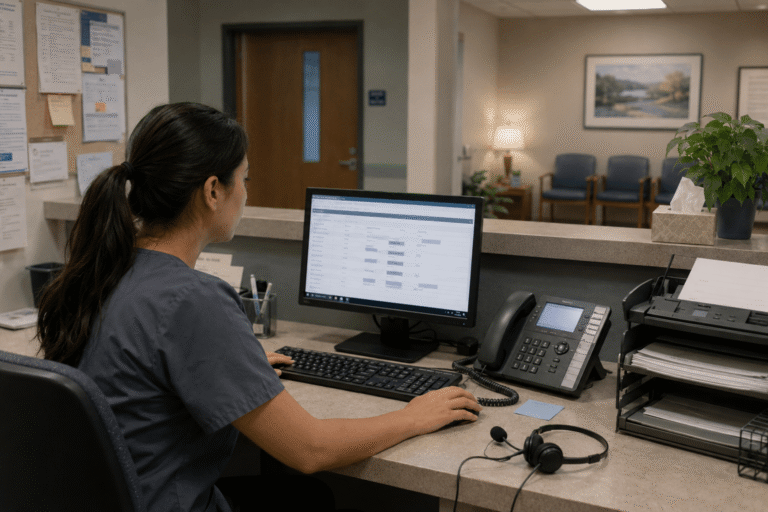

Healthcare practices handle sensitive patient information daily through phone calls, messages, and documentation. Standard business VoIP services often fall short when applied to medical environments because they lack the specialized safeguards, workflows, and reliability that clinical teams require. Understanding these differences helps practice owners and administrators select systems that support secure, efficient patient communication while meeting regulatory obligations.
Missed calls, scattered text messages, and voicemails buried in separate apps can slow patient communication and add compliance risk. RingRx brings voice, secure texting, fax, video, and on-call communication into one platform designed to support HIPAA-compliant healthcare communication workflows. Start your RingRx free trial today.
Key Takeaways
- Healthcare phone systems must treat voice conversations and messages containing protected health information as electronic PHI, requiring specific technical safeguards and risk management that general VoIP rarely provides out of the box.
- Healthcare practices need to evaluate how any VoIP service handles protected health information, including vendor responsibilities, security controls, configuration, and BAA availability.
- Medical practices benefit from routing, escalation, and after-hours workflows designed around clinical triage and staff handoffs rather than generic customer service queues.
- Choosing the right system reduces administrative burden and supports consistent patient response without compromising security or compliance.
- Practical evaluation focuses on how well the platform integrates into daily operations rather than feature checklists alone.
Why General VoIP Often Falls Short in Healthcare Settings
Many practices initially explore general VoIP for its cost savings and cloud flexibility. These platforms excel at everyday business calls, offering features like auto-attendants and voicemail transcription. However, once protected health information enters the conversation, the requirements change significantly.
Voice data transmitted over the internet becomes electronic protected health information. This triggers the full HIPAA Security Rule, demanding safeguards for confidentiality, integrity, and availability. Security capabilities vary by provider and plan. Healthcare organizations should verify the controls included and document their risk-management decisions.
The transition to digital telephony in healthcare has accelerated, replacing legacy systems with platforms that digitize voice communications and transmit them over the internet, which immediately raises the bar for how protected health information is handled. VoIP systems and HIPAA compliance requirements highlight how digitized conversations containing PHI become ePHI that must adhere to the full suite of HIPAA Privacy, Security, and Breach Notification Rules. Organizations implementing these systems must conduct thorough market research to identify platforms that support encrypted transmissions, robust authentication, and audit logging as core capabilities rather than afterthoughts. Establishing a business associate agreement with third-party providers ensures clear delineation of responsibilities for safeguarding data during calls, recordings, or message storage, while recurring risk assessments document and mitigate threats specific to telephony infrastructure.
Without the right foundation, practices risk gaps in access controls, audit trails, or vendor responsibilities. This distinction explains why many healthcare organizations move beyond consumer-grade or basic business VoIP to purpose-built solutions.
HIPAA Compliance Requirements for Phone Communications
HIPAA applies whenever patient details are discussed or stored in digital systems. For phone systems, this means treating calls, voicemails, and text messages as regulated channels. Covered entities must implement appropriate safeguards based on HIPAA requirements and their risk analysis. Specific controls should be reviewed with qualified compliance professionals.
Healthcare organizations face a critical moment in how they handle patient communications as traditional phone systems give way to digital solutions that transmit voice data over the internet. When providers discuss protected health information during calls or sessions, that conversation becomes electronic protected health information, or ePHI, triggering strict requirements under the HIPAA Security Rule. HHS guidance on HIPAA and remote communication technologies makes clear that covered entities must apply appropriate safeguards whenever electronic media are used for transmission or storage, including risk assessments to identify threats like interception or unauthorized access. Organizations must evaluate encryption in transit and at rest, user authentication, automatic session termination, and audit capabilities to protect confidentiality, integrity, and availability of sensitive data.
A standard VoIP setup might handle calls effectively but often lacks the built-in audit logging and reporting needed for compliance reviews. Healthcare phone systems address this by maintaining detailed activity records that help practices demonstrate adherence during audits or breach investigations.
Establishing a business associate agreement with the provider becomes essential when the system creates, receives, or maintains PHI. This agreement clarifies responsibilities for data protection. Practices should verify that their chosen platform supports these agreements and provides the documentation required for risk management processes.
Security Features Designed for Clinical Environments
Security in healthcare communications extends beyond basic password protection. Systems built for medical use incorporate role-based access controls, secure voicemail storage, and protections against unauthorized listening or transcription access. These measures help prevent accidental exposure during routine operations.
General VoIP platforms may prioritize convenience features like easy forwarding or integration with consumer apps. In contrast, healthcare solutions emphasize controls that align with privacy standards, such as limiting message retention periods or requiring explicit consent for certain communication channels.
Staff training on proper system use complements these technical features. Clear policies around handling sensitive calls and messages reduce human-error risks that technology alone cannot eliminate. Practices benefit from platforms that make compliant behaviors the default rather than requiring constant manual adjustments.
Workflow and Routing Needs Specific to Medical Practices
Patient calls in a medical setting rarely follow simple sales or support patterns. A single call might involve urgent triage, prescription refills, appointment scheduling, or coordination between providers. Healthcare phone systems support intelligent routing based on clinical needs, time of day, and staff availability.
After-hours coverage, on-call escalation, and seamless handoffs between team members help prevent missed communications that could affect patient care. General VoIP often relies on basic queues or menus that do not account for the variable demands of a medical practice, such as prioritizing emergency lines or routing to appropriate clinical staff.
Integration with existing practice management tools further streamlines operations. When calls connect directly to patient records or trigger appropriate follow-up workflows, administrative time decreases and care coordination improves.
Patient Communication and Experience Considerations
Patients expect timely, professional responses whether calling during business hours or leaving a message after hours. Healthcare communication systems help practices meet these expectations while maintaining appropriate boundaries around sensitive information.
Features such as organized voicemail, reliable text messaging with consent protocols, and clear escalation paths contribute to smoother interactions. These elements reduce frustration for both patients and staff by minimizing hold times and lost messages.
Unlike general business tools focused on volume metrics, healthcare systems emphasize reliability and documentation that support continuity of care. This focus helps practices build trust through consistent, secure communication channels.
How RingRx Helps
- Route calls so the right person gets the right call based on practice-specific rules and clinical needs.
- Support after-hours workflows with clear escalation paths and reliable voicemail handling.
- Reduce unwanted calls while keeping lines open for genuine patient needs.
- Keep communication organized across phone, text, voicemail, and fax in one compliant platform.
- Provide transparent operations that help practices maintain control over their communication workflows.
Evaluating and Selecting the Right Healthcare Phone System
Practices comparing options should look beyond basic calling features. Focus on how well the system addresses compliance documentation, workflow customization, and integration with daily operations. Request demonstrations that show real clinical scenarios rather than generic sales pitches.
Consider the vendor’s experience with healthcare organizations and willingness to sign a business associate agreement. Review available audit and reporting capabilities, as these become critical during compliance reviews.
Start with an assessment of current pain points missed messages, inefficient routing, or concerns about security to guide the decision. The goal is a system that supports your team’s workflow instead of adding new administrative tasks.
Healthcare phone systems serve a distinct purpose compared to general VoIP. By prioritizing compliance, security, and clinical workflows, practices can maintain high standards of patient communication while protecting sensitive information. This thoughtful approach strengthens operations and supports better care delivery.
Frequently Asked Questions
What makes healthcare phone systems different from general VoIP solutions?
When a service creates, receives, maintains, or transmits ePHI, the practice must evaluate applicable HIPAA safeguards and vendor obligations, including whether a BAA is required. General VoIP focuses on basic calling features and often lacks these specialized safeguards and clinical workflows.
How do healthcare phone systems ensure HIPAA compliance for patient communications?
They implement technical safeguards like encryption in transit and at rest, secure authentication, and automatic session termination, plus detailed audit logging. Practices also establish business associate agreements with providers for clear data protection responsibilities.
What workflow features make healthcare phone systems better for medical practices?
They offer intelligent routing based on clinical needs, time of day, staff availability, and after-hours escalation. This reduces missed calls, supports seamless handoffs, and integrates with patient records to improve care coordination.
Disclaimer: This article is for general informational purposes and is not legal advice. Practices should review communication, privacy, and compliance policies with their legal, compliance, or administrative teams.
You may also be interested in: RingRx vs Google Voice: Healthcare VoIP Comparison
Missed calls, scattered text messages, and voicemails buried in separate apps can slow patient communication and add compliance risk. RingRx brings voice, secure texting, fax, video, and on-call communication into one platform designed to support HIPAA-compliant healthcare communication workflows. Start your RingRx free trial today.
Powered by flareAI.co