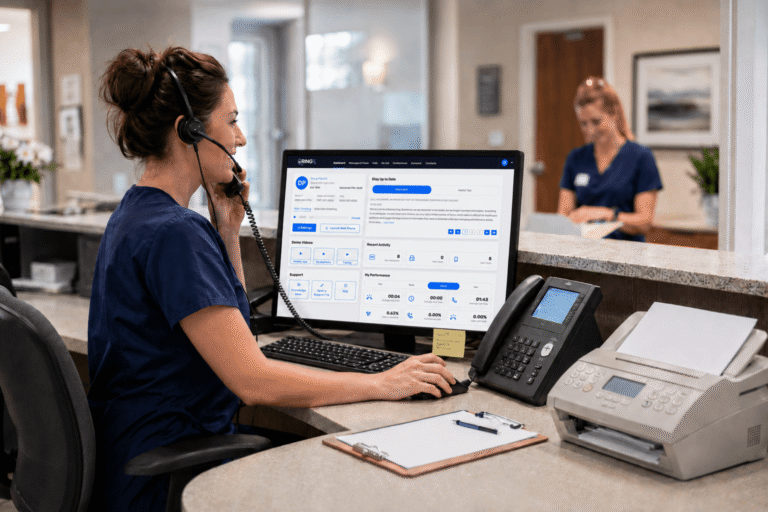

Missed calls, scattered text messages, and voicemails buried in separate apps can slow patient communication and add compliance risk. RingRx brings voice, patient texting and secure team messaging, fax, video, and on-call communication into one platform designed to support HIPAA-compliant healthcare communication workflows. Start your RingRx free trial today.
RingRx encrypts team messages exchanged within its platform. Patient SMS leaves the platform and does not have the same security protection; practices must manage consent, message content, and patient-texting policies accordingly.What Should a Practice Compare Before Switching Communication Platforms?
Start with the work your team performs every day. A healthcare communication platform should be evaluated against the actual flow of calls, messages, voicemails, faxes, video interactions, and after-hours communication rather than against an abstract list of software capabilities.- Communication coverage: Identify whether the platform supports the phone, text, fax, and video workflows your practice needs.
- Call handling: Review automated call routing, auto-attendant behavior, voicemail, on-call management, and escalation paths.
- Staff workflow: Determine how communication is assigned, handed off, reviewed, and managed across front-office and clinical teams.
- Security and compliance: Examine the safeguards, contractual arrangements, access controls, and internal policies that apply to your environment.
- Cost visibility: Evaluate whether pricing information makes expected communication costs easier to understand and budget.
- Migration requirements: Plan number porting, call-flow setup, testing, staff training, and cutover before the switch.
How Should RingRx and Spruce Health Be Evaluated Without Relying on Feature Lists?
A useful comparison starts with scenarios. Instead of asking whether each platform has a particular feature, ask how each option handles the communication event from intake through resolution.- An incoming patient call: Map where the call goes, what happens when the intended person is unavailable, and how after-hours escalation works.
- A patient text: Review consent, minimum-necessary communication practices, staff ownership, response expectations, and escalation when a message requires clinical attention.
- A voicemail: Determine how messages are captured, accessed, reviewed, and handed off.
- A faxed document: Examine how documents enter the workflow and how staff manage the resulting communication or follow-up.
- A remote interaction: Consider how video communication, follow-up, reminders, messaging, and documentation fit around the interaction.
What HIPAA and Security Questions Matter When Comparing Healthcare Platforms?
Healthcare organizations should treat a vendor’s healthcare focus or compliance-oriented language as one part of the evaluation, not as a substitute for reviewing the practice’s own responsibilities. The comparison should address what services are covered, what safeguards apply, what contractual arrangements are required, and how access and audit visibility are handled.- Does the proposed arrangement include the contractual documentation the practice requires?
- How are user access and authentication managed?
- What audit visibility is available to appropriate administrators?
- How does the platform fit the practice’s mobile, remote, and after-hours communication patterns?
- What responsibilities remain with the practice after implementation?
Which Workflow Differences Deserve the Most Attention?
The most useful comparison focuses on operational handoffs. A communication platform affects who receives an incoming request, how quickly the request reaches the right person, what happens when that person is unavailable, and how the team knows whether follow -up remains outstanding.- Routing: Review whether calls can follow defined paths instead of depending on informal transfers.
- After-hours coverage: Define who receives calls outside normal office hours and what escalation rules apply.
- Voicemail: Assess whether voicemail review fits existing staff responsibilities without creating another isolated queue.
- Communication consolidation: Consider how phone, text, voicemail, fax, and video workflows are organized.
- Staff handoffs: Identify where communication can become stranded between front-office, administrative, and clinical roles.
How Should a Practice Evaluate Cost and Pricing Before Switching?
Cost should be evaluated as the full communication workload, not only as the stated software price. Practices should identify the people, tools, processes, and rework associated with current communication and then determine which costs are likely to remain after a change.- List current communication tools and overlapping functions.
- Estimate the staff time devoted to voicemail review, manual routing, fax handling, and follow-up.
- Identify missed-call and handoff points that create additional administrative work.
- Review pricing terms so expected communication costs can be understood before implementation.
- Separate verified pricing information from assumptions about future savings.
What Should a Practice Plan Before Moving From Spruce Health?
Switching communication platforms is an operational change, so preparation should begin before the cutover date. The practice should document the current communication model and then reproduce the necessary workflows in the new environment.- Document current call flows: Record main lines, departments, extensions, after-hours paths, voicemail behavior, and escalation rules.
- Plan number porting: Identify numbers that need to move and establish ownership for the porting process.
- Configure workflows: Recreate routing, on-call coverage, voicemail, fax, texting, and other required communication paths.
- Test before cutover: Test representative calls and communication scenarios rather than assuming configuration is correct.
- Train staff: Make responsibilities clear for calls, messages, voicemail, documents, and escalations.
- Define the cutover: Assign ownership for the transition and verify that critical communication paths are functioning.
When Is RingRx a Practical Option to Evaluate?
RingRx is positioned as a healthcare-focused cloud communications platform for medical practices, clinics, and healthcare organizations. Its stated communication scope includes HIPAA- compliant phone, text, fax, and video communication, with capabilities such as call routing, virtual receptionists, on-call management, voicemail transcription, and mobile and desk phone integration. The strongest evaluation is therefore use-case based. A practice should determine whether those capabilities match its actual communication requirements and whether the platform can support the desired workflows. RingRx also describes transparent pricing as a differentiator. Practices evaluating alternatives should still review their own communication costs and requirements rather than treating pricing language as evidence of a particular financial outcome. If the next step is to examine the platform against your current communication model, as part of a structured evaluation of workflows, responsibilities, and implementation requirements.Frequently Asked Questions
Is RingRx HIPAA Compliant?
RingRx is described as providing HIPAA-compliant phone, text, fax, and video communication solutions. Practices still need appropriate policies, safeguards, access controls, and other measures because technology alone does not make an organization compliant.
What Should a Practice Compare When Evaluating Spruce Health Alternatives?
Compare phone, text, fax, video, voicemail, routing, after-hours coverage, staff handoffs, security responsibilities, pricing clarity, and migration requirements. Evaluate those areas against real workflows rather than feature names alone.
What Should Be Tested Before Switching Communication Platforms?
Test representative call flows, after-hours routing, voicemail, texting, fax workflows, staff handoffs, and other communication paths that are important to daily operations. Confirm that staff understand their responsibilities before cutover.
Does Switching Platforms Automatically Reduce Communication Costs?
No. The financial effect depends on the practice’s existing tools, staff time, communication workload, workflow design, and implementation. A sound comparison should identify current communication waste and expected costs before making a savings claim.
Disclaimer: This article is for general informational purposes and is not legal advice. Practices should review communication, privacy, and compliance policies with their legal, compliance, or administrative teams. You may also be interested in: How Cloud Solutions Streamline Hospital CommunicationMissed calls, scattered text messages, and voicemails buried in separate apps can slow patient communication and add compliance risk. RingRx brings voice, patient texting and secure team messaging, fax, video, and on-call communication into one platform designed to support HIPAA-compliant healthcare communication workflows. Start your RingRx free trial today.
Powered by flareAI.co