
Quick Listen:
5G telehealth services can support faster, more stable communication for virtual visits, remote monitoring, and other healthcare workflows that depend on reliable connectivity.
Telehealth no longer means only a basic video appointment. Practices may use virtual visits, secure messaging, phone calls, remote monitoring, fax workflows, and follow-up communication around the same patient interaction.
Better network performance can help those workflows run more smoothly, but 5G does not solve every telehealth challenge on its own. Practices still need secure platforms, clear policies, staff training, and workflows that fit real patient communication needs.
Missed calls, scattered text messages, and voicemails buried in separate apps can slow patient communication and add compliance risk. RingRx brings voice, secure texting, fax, video, and on-call communication into one HIPAA-compliant platform built for healthcare workflows. Start your RingRx free trial today.
Why 5G Telehealth Services Matter
5G telehealth services matter because virtual care depends on reliable communication. When a video visit freezes, a call drops, or remote patient data arrives late, staff and patients both feel the friction.
5G can help by offering faster speeds, lower latency, and better support for connected devices where coverage is available.
The practical value is not the network alone. It is how better connectivity supports the communication workflows around care.
How 5G Can Support Virtual Visits
Virtual visits depend on stable video and audio. Better connectivity can reduce interruptions, improve call quality, and make it easier for patients and providers to complete the visit without repeated reconnection attempts.
This can be especially useful when patients join from mobile devices or when providers support remote and hybrid care workflows.
However, a good telehealth experience still depends on more than bandwidth. Practices also need clear scheduling, reminders, follow-up, and support when patients have trouble joining a visit.
Remote Monitoring Needs Reliable Communication
Remote patient monitoring can generate data from connected devices such as blood pressure cuffs, glucose monitors, pulse oximeters, or other approved tools.
5G may help support faster and more consistent data transmission where network coverage is strong. That can help care teams review information more quickly.
Practices still need rules for who reviews incoming data, what triggers follow-up, and how patients should respond if they have an urgent concern.
Where 5G Fits With Phone, Text, Fax, and Video
5G telehealth services are only one part of the communication picture. Patients still call, text, leave voicemails, receive reminders, and need documents sent by fax.
Those channels should not sit in disconnected systems. A strong telehealth workflow connects video, phone, text, voicemail, fax, routing, and follow-up so staff can manage the full patient interaction.
Better network performance helps, but workflow design determines whether communication is actually easier to manage.
How RingRx Supports Telehealth Communication
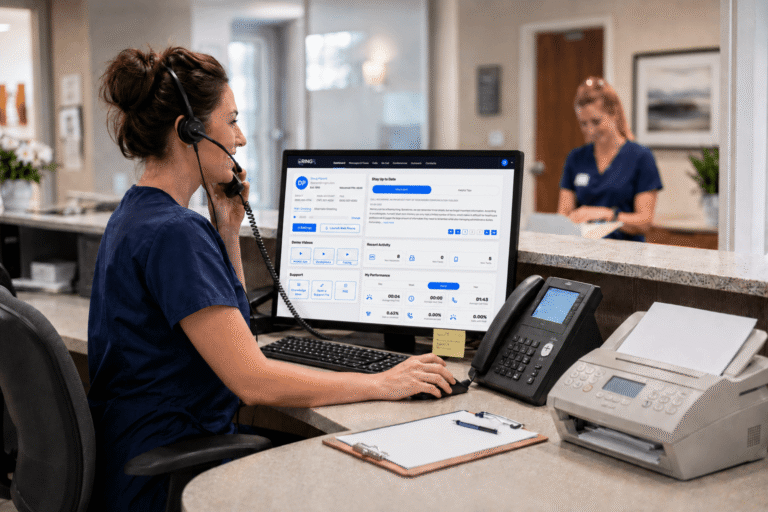
RingRx gives healthcare practices a HIPAA-compliant communication platform for phone, secure texting, fax, video, voicemail, call routing, and on-call workflows.
For practices using 5G telehealth services or other virtual care tools, RingRx helps organize the communication around the visit. Staff can route calls, send approved texts, manage voicemail, support video communication, handle fax workflows, and coordinate after-hours coverage from one healthcare-focused platform.
RingRx also supports HIPAA-focused communication workflows, helping practices reduce reliance on disconnected tools.
What 5G Does Not Solve by Itself
5G does not automatically make a telehealth workflow secure, organized, or compliant. Practices still need healthcare-focused systems and clear communication policies.
Coverage can also vary by location. Some rural or underserved areas may not yet have reliable 5G access, and some patients may lack compatible devices or be uncomfortable with digital tools.
Practices should treat 5G as one enabler, not the full telehealth strategy.
Security and HIPAA Still Matter
Telehealth communication can include protected health information, so practices need tools and processes that support HIPAA-compliant workflows.
That includes appropriate safeguards, access controls, vendor agreements, and staff rules for phone, text, fax, video, voicemail, and remote monitoring communication.
The safest setup makes the approved workflow easier than the workaround.
Questions Practices Should Ask About 5G and Telehealth
Before relying on 5G or any telehealth platform, practices should ask practical workflow questions.
- Do patients in our service area have reliable 5G or broadband access?
- Can staff manage phone, text, fax, video, voicemail, and routing from a single platform?
- Can patients receive approved reminders and follow-up messages?
- Who reviews remote monitoring data, and when?
- Does the vendor support HIPAA-related safeguards and BAA coverage?
- Can calls route by provider, department, schedule, or availability?
- Can after-hours communication follow clear escalation rules?
- Is pricing clear before the practice commits?
What to Avoid With 5G Telehealth Services
Practices should avoid assuming that faster connectivity fixes a disorganized workflow. If calls, texts, video, fax, and voicemail are scattered across multiple networks, 5G will not resolve the underlying handoff problem.
They should also avoid promising always-on monitoring or immediate responses unless the practice truly has the staffing and workflow to support it.
The better approach is to use improved connectivity to support defined, healthcare-appropriate communication workflows.
Final Thoughts
5G telehealth services can support better connectivity for virtual visits, remote monitoring, and healthcare communication when coverage and devices are available.
The real value comes when better connectivity works with clear workflows for phone, secure texting, fax, video, voicemail, routing, and follow-up.
RingRx helps healthcare practices manage those communication channels in one HIPAA-compliant platform built for medical workflows.
Frequently Asked Questions
How does 5G support telehealth services?
5G can support telehealth services by improving speed, reducing latency, and helping connected devices transmit information more reliably where coverage is available.
Can 5G improve virtual visits?
5G may improve virtual visits by supporting more stable video and audio connections, especially for mobile users in areas with strong coverage.
Does 5G make telehealth HIPAA-compliant?
No. 5G is a network technology. HIPAA-compliant telehealth still depends on appropriate platforms, safeguards, vendor agreements, and practice policies.
What should practices consider before using 5G telehealth services?
Practices should consider local coverage, patient device access, workflow fit, HIPAA-related safeguards, staff responsibilities, and how communication will be managed before and after visits.
This article is for general informational purposes and is not legal advice. Practices should review communication policies with their compliance, legal, or administrative teams.
You may also be interested in: Failed a HIPAA Audit? 7 Steps for Practices – RingRx
Missed calls, scattered text messages, and voicemails buried in separate apps can slow patient communication and add compliance risk. RingRx brings voice, secure texting, fax, video, and on-call communication into one HIPAA-compliant platform built for healthcare workflows. Start your RingRx free trial today.