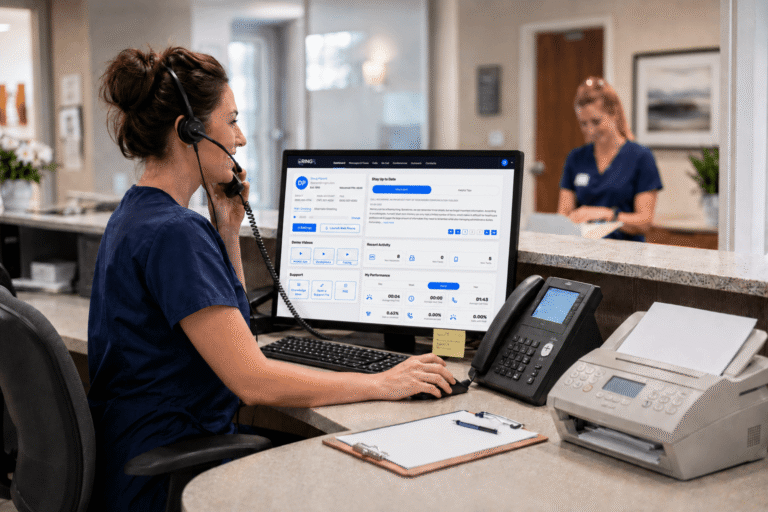

A medical office administrator reviews compliance materials at her desk, surrounded by folders and paperwork, preparing calmly for a HIPAA audit.
Key Takeaways
-
HIPAA audits make proactive security essential for every medical practice.
-
Readiness depends on documented risk analyses and audit trails for PHI.
-
Cloud-based VoIP systems like RingRx secure calls, texts, and voicemails with encryption and logs.
-
Centralized audit trails support transparency and accountability during reviews.
-
Ongoing staff training helps prevent errors and compliance gaps.
-
With the right tools, practices of any size can stay secure and audit-ready — without added complexity.
HIPAA audits can be stressful – but they’re not box-checking exercises. Auditors from the Office for Civil Rights (OCR) want evidence that your systems, policies, and processes actually protect patient data. That includes communication systems like your phone platform.
In 2025, the OCR launched its third phase of HIPAA compliance audits targeting 50 covered entities and business associates. One of the primary reasons for this new audit phase? The OCR reported in March 2024 that there has been a 256% increase in significant data breaches involving hacking and a 264% increase in ransomware attacks over the past five years.
One of the most overlooked sources of PHI is your phone system. A HIPAA-compliant VoIP phone system helps your practice communicate securely (and stay audit-ready) while improving patient care and operations.
- Lindsey Meekins, Practice Manager, Trauma Specialists of Maryland
Before we dive into how RingRx helps, here’s what HIPAA audits actually involve – and why they matter. Also, note that HIPAA Security Rule regulations apply to all patient communications, including messages sent via text or phone and electronic health records (EHRs) stored in the healthcare facility, the cloud, or other locations.
Why HIPAA Audits Are Serious Business
Under the HITECH Act, HHS is required to periodically audit covered entities and their business associates for compliance with the HIPAA Privacy, Security, and Breach Notification Rules. OCR’s HIPAA Audit Program uses a detailed audit protocol to assess how well organizations protect individually identifiable health information and grant individuals the right to access it.
The HIPAA Privacy Rule has two core responsibilities:
- Protect individually identifiable health information from impermissible use and disclosure
- Provide individuals with rights over their protected health information (PHI)
Covered entities must also create and maintain an audit trail for all electronic PHI (ePHI) in their possession, including where it originates and how it’s used, disclosed, and stored. During an audit, the OCR may request your policies, procedures, training records, business associate agreements (BAAs), incident logs, and technical audit logs.
Every covered entity and business associate is subject to audit. If a vendor mishandles PHI, your practice is still accountable. That includes communication providers like your phone or messaging vendor.
Three Key Components of a HIPAA Security Audit
While every part of HIPAA compliance matters, auditors often focus on three areas where many practices fall short:
Inventory and Audit Trail of PHI
If you don’t know where your PHI lives — who touches it, how it moves, and where it’s stored — you can’t secure it or prove it during an audit.
Implementation and Configuration of Software
It’s not enough to say you use HIPAA‑compliant technology solutions. The solutions must be properly configured to include automatic logouts, unique user IDs, data-at-rest and in-transit encryption, access controls, and multi-factor authentication. Auditors expect to see documented configurations and active monitoring.
Workforce Training and Compliance Monitoring
Everyone in your practice must complete security awareness training. Even staff who don’t handle PHI directly. You must keep training records and monitor compliance – a step many smaller practices overlook.
How a HIPAA‑Compliant VoIP System Improves Audit Readiness
PHI flows through your phone system during appointment calls, voicemails, callbacks, and prescription requests. As we mentioned in a previous blog, HIPAA voicemail must be fully encrypted and stored across multiple geographies simultaneously to eliminate single points of failure. Your communication platform deserves the same compliance standards as your EHR or email. A HIPAA-compliant VoIP system supports key audit-readiness requirements, including:
End-To-End Encryption
One of the most common HIPAA violations is failing to encrypt ePHI on mobile or portable devices. All communications, including messages and files, should be encrypted to prevent unauthorized access. The right phone system makes it easy to provide configuration details and vendor documentation during an OCR audit.
Audit Logs And Call Metadata
Compliant VoIP systems generate detailed logs that include call metadata, user access, voicemail activity, and message forwarding. That directly supports your audit trail obligations.
Business Associate Agreement
If your VoIP provider handles PHI, a signed BAA is required to define permitted uses and security responsibilities.
Centralized Role‑Based Administration
Cloud VoIP platforms support role-based access, user deactivation, and control over voicemail and recording permissions. This strengthens access controls and makes them easier to document during an audit.
Secure Voicemail, Recordings, And Retention Policy
Voicemails and recorded calls containing PHI must be encrypted, access-restricted, and managed in accordance with your retention policy. A compliant VoIP system ensures your communication tools align with your retention and deletion policies.
Five Steps to Audit‑Ready With RingRx
HIPAA audits are on the rise, and every practice (regardless of size) must be prepared. For busy practice administrators, that means simplifying compliance and ensuring every system (including your phone platform) is audit-ready.
RingRx’s HIPAA-compliant VoIP system helps you strengthen your communication audit trail, enforce technical safeguards, and demonstrate security best practices during an audit. Follow these five steps to prepare your practice for an OCR audit:
Conduct A Risk Analysis.
- Define the scope (i.e., systems, communications, phone systems, vendors).
- Collect data, including where PHI is accessed, stored, and transmitted.
- Identify threats and vulnerabilities (i.e., unauthorized access, ransomware, device loss).
- Assess current security controls (i.e., encryption, logs, access controls).
- Document the likelihood and impact of each risk, and determine the risk level.
- Finalize documentation and schedule annual or change‑trigger reviews.
Implement a Risk Management Plan.
- Based on your risk analysis, develop controls and mitigation steps with owners and their timelines.
- Include your VoIP system (like RingRx) as a defined control in your plan.
Review and Update Your Policies and Procedures.
- Cover phone/voicemail/communication systems, remote access, encryption, retention/deletion.
- Track version history, review dates, and staff acknowledgments.
Train and Monitor Your Workforce.
- Provide annual HIPAA privacy and security training (including policies for phone and voicemail systems).
- Use RingRx logs to review access to patient communications and voicemail activity.
Organize Your Documentation.
- BAAs (including with RingRx)
- Risk assessments and documented mitigation plans
- Training records
- System and communication audit logs
- Incident response plans and records of past security events
When OCR auditors arrive, you should be able to produce:
- A recent risk assessment and mitigation plan
- Current policies and staff training records
- Signed BAAs with all vendors (including your VoIP vendor)
- Evidence of encryption settings, access controls, and system configuration
- Retention and deletion policy for all HIPAA-covered communications
RingRx: Your Best Choice for HIPAA-Compliant Communications
RingRx was purpose-built for healthcare, with a HIPAA-compliant phone system that supports secure, compliant communication without added complexity. Every RingRx account includes a signed BAA so that you can communicate with patients confidently and securely.